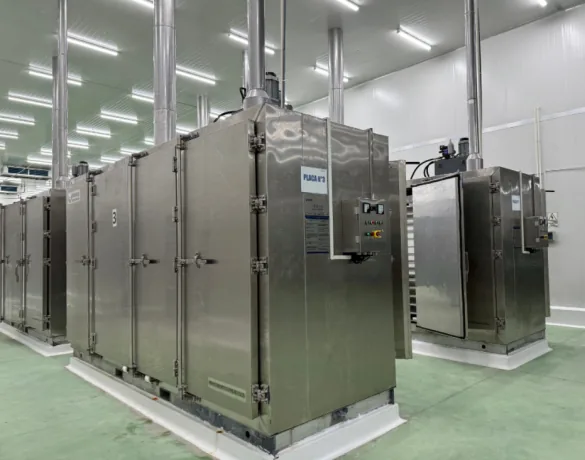
The awkward question in a plate-freezer purchase is usually the shortest one: how long will it take?
I understand why buyers ask. A production plan needs a number. But a bare number can hide almost everything that makes the answer useful. Which seafood block? What package? What temperature when it enters, and where will the final temperature be measured? If those details are missing, a cycle time has no firm boundary.
So I start with the pack on the factory floor, not the model name in a quotation. It is less tidy. It is also much harder to misunderstand.
MOON-TECH describes contact freezing as refrigeration passing to food through a metallic freezing plate. Its MPF series uses double-sided contact freezing with intermittent loading and unloading. That tells us how the equipment is arranged. It does not create one cycle time for every seafood product.
Put an ordinary production block on the desk
A drawing is useful, but I still want to see a normal filled pack. The mould might say 80 mm while production gives a range. Liners wrinkle. Cartons bow. A fill weight drifts within its allowed tolerance. None of that is unusual, yet it belongs in the selection conversation.
My first notes are simple: seafood species, product form, actual length and width, observed thickness range, and filled weight. I also note whether the product is raw or cooked and whether glaze is present. If a tray, liner or carton sits between the food and the plate, it goes on the same page.
The face that meets the plate deserves a photograph. Is it flat? Does a lid rise in the middle? Is there a seam or folded liner? I do not use that photograph to calculate a result on my own. I send it so the equipment supplier can review the real contact arrangement instead of an ideal rectangle.
FAO guidance on fish freezing discusses the influence of product dimensions, starting and final temperature, heat-transfer conditions and packaging on freezing time. That is the useful industry context here. A product description and a temperature basis should travel beside any proposed cycle.
Read the small note under the capacity table
The MPF capacity reference has a specific basis: hairtail fish, trays measuring 600 × 400 × 80 mm, and 15 kg in each tray. It is easy to copy the capacity figure and leave that line behind. I keep them together.
Suppose the inquiry is for thicker blocks in a different carton. The published figure still helps identify the reference case, but it is not a promise for the new pack. The clean next step is to give MOON-TECH the new product data and request a project-specific selection basis.
This also clears up a common mix-up between batch load and shift output. One describes what goes into a cycle. The other depends on the whole production window and on whatever activities the calculation includes. Does the stated cycle cover only freezing? What about opening, loading, closing, unloading or a product change? I write those questions in the margin before comparing suppliers.
If the product is still being developed, I say so. An honest blank cell is safer than a guessed thickness that later becomes contractual. The supplier can then say whether a sample, drawing or trial is needed.
Picture the MPF sequence before discussing handling
The MPF description is quite concrete. Food is placed between multiple freezing plates. Hydraulic action opens the plates for loading and unloading, then presses them down for freezing. The mode is double-sided contact and the loading is intermittent.
That description applies to the MPF series. I would not stretch it into a claim about every plate freezer.
For a buyer, it is enough to prompt a few practical checks. Which package thickness range is being considered? What arrangement supports the quoted batch? How will packs be placed between the plates? What handling work is included in the proposed scope?
I prefer answers on a drawing or data sheet. A phone call can settle today's doubt, but written project documents let production, purchasing and the supplier look at the same basis months later.
The MOON-TECH plate freezer product route gives the equipment context. The actual seafood block still needs its own review.
Give the RFQ enough detail to be challenged
A good RFQ does not have to sound technical. It does need to expose its assumptions.
I usually put one product per line rather than making an average seafood block that the plant never runs. Beside each SKU go the pack dimensions, filled weight, thickness range, package material and normal loading temperature. Then I add the required temperature and the intended measurement point. If the plant has not chosen a measurement method, that becomes a question for the proposal, not a silent guess.
The production request comes next. There may be a batch target, a shift target, or both. Available hours matter. So do planned changes and cleaning windows if they affect the expected output. I want the supplier to state the number of cycles assumed and what one cycle contains.
Site information can stay factual. What refrigeration arrangement already exists? Which utilities are available? How much room and access does the layout provide? I avoid designing the connections in the inquiry. Instead, the proposal should identify connection points, condenser needs, electrical data, drainage, service clearance and removal space for the selected configuration.
That last distinction is important. A buyer can describe the plant. The supplier confirms the equipment interface.
A trial needs a question, not just a stopwatch
When the product case is uncertain, a trial may be the sensible route. Before arranging one, I write down what it is meant to prove.
Are we checking the centre temperature of a representative block? Uniformity across several positions? The handling sequence? A complete production cycle? Those are related questions, but they are not identical.
For the test itself, I would use ordinary production material where possible and keep the actual sample dimensions. Starting temperatures and measurement positions need to be visible in the record. Loading and unloading should have their own times instead of disappearing inside one total. If one block is slow, it stays in the notes. Removing it because it spoils the average only moves the argument to commissioning day.
The result should be described narrowly. A successful run for one package does not approve every SKU. A centre-temperature check does not automatically validate a full shift-output claim. FAO material on fish freezers helps explain the industry variables, while the buyer and supplier still have to agree on the project test method.
This is the point where a short written protocol earns its keep. It prevents two people from watching the same trial and leaving with different conclusions.
Decide what the refrigeration scope actually includes
MOON-TECH describes the MPF-(F)Z series as an MPF contact freezer and its matching refrigeration compressor condensing unit installed together on a common base. The combination forms an integral quick-freezing system with its own refrigeration source.
That is a useful configuration fact, not a universal recommendation. A plant with an existing refrigeration system starts from a different place than a separate processing room that needs a packaged source.
I would ask the proposal to draw a clear scope boundary. What arrives on the common base? What connects to plant services? Which items remain by others? Condenser form and site interfaces are project-specific and model-specific, so they belong in the confirmed offer.
The same habit helps with controls, installation work, commissioning support and spares. If the purchase depends on an item, give it a line in the scope table. "We thought it was included" is expensive project language.
Compare assumptions before comparing minutes
When two quotations show very different cycle times, I do not begin by circling the faster one. I put the product basis side by side.
Same block thickness? Same loading temperature? Same centre-temperature target? Same package? Same definition of a cycle?
Sometimes the difference remains after that check, and the supplier can explain it. Often the proposals simply answered different questions. A compact comparison sheet with columns for confirmed, to be tested and not stated makes this visible quickly.
For a project review, the seafood specification, pack photographs and production target can go through the MOON-TECH project contact route. I would ask for the selection basis and any remaining trial requirement in the response.
Conclusion
There is no need to make a plate-freezer inquiry complicated. It just needs to stay attached to a real product.
Start with the seafood block and package. State the temperature route. Separate batch load from shift output. Keep the MPF table's hairtail-tray reference beside its capacity figure, and use the MPF operating description only within its stated scope. If evidence is missing, mark the gap and decide how it will be closed.
The answer may take longer than a one-line request for tonnes per shift. It will be far more useful when the equipment reaches the plant.
FAQ
What should I send before requesting a freezing cycle?
Send the seafood form, actual package dimensions, thickness range, filled weight, loading temperature, required final temperature and proposed measurement point. Include the batch or shift target and photographs of a normal pack.
Can I apply the MPF table capacity to another seafood product?
Treat it as a reference only. Its stated basis is hairtail fish in 600 × 400 × 80 mm trays with 15 kg per tray. A different product or package needs project-specific confirmation.
What does double-sided contact mean for the MPF series?
Food is placed between multiple freezing plates. Hydraulic action opens them for handling and presses them down for freezing. This description does not set a universal cycle time.
Should a production trial include handling time?
It should record handling separately if output is part of the decision. Agree in advance whether the acceptance figure covers freezing alone or a complete operating cycle.
What is an MPF-(F)Z system?
It combines an MPF contact freezer with its matching refrigeration compressor condensing unit on a common base. Condenser form and site interfaces still depend on the selected model and project.